
4.1 Organization of Oncology Research
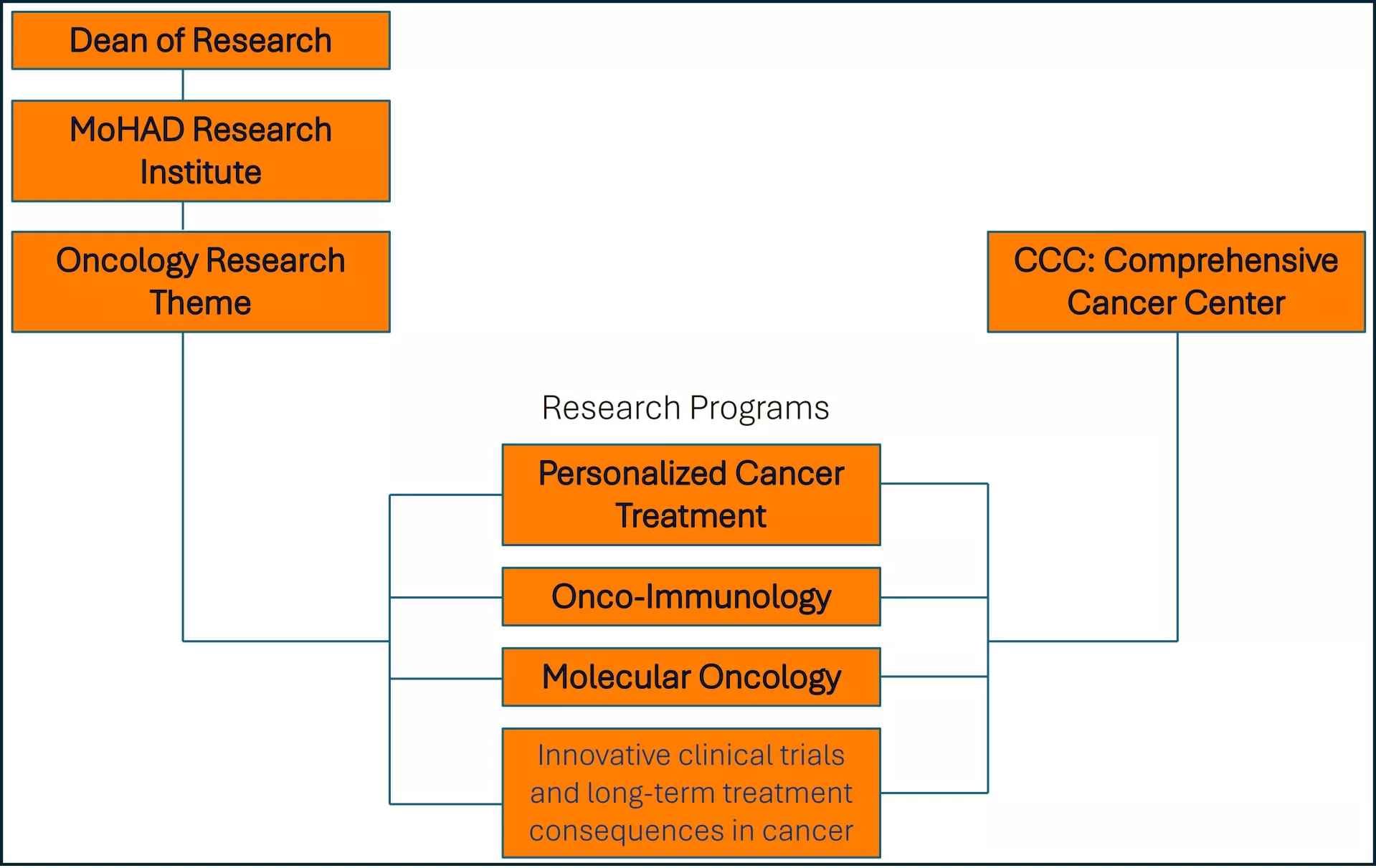
In 2023, the entire UMCG organization was restructured. This included changes to the research structure. The previous Cancer Research Center Groningen (CRCG) Institute became embedded into the new Research Institute for Mechanisms of Health, Aging and Disease (MoHAD) as a dedicated ‘Oncology Research theme’. The four research programs of CRCG were continued within MoHAD (DAmage and REpair in cancer development and cancer treatment (DARE); GUided Treatment in optimally Selected cancer patients: translational and clinical research in oncology (GUTS); Stem cells, Aging, Leukemia and Lymphoma (SALL); and TARgeted Gynaecologic Oncology (TARGON)). After its first year of functioning, the MoHAD management team determined that a restructuring of the programs within the institute was a next step to create a stimulating and active research community, and would better align with the research strengths of the UMCG.
In 2024 all four previous oncology research programs (DARE, GUTS, SALL, TARGON) were stopped. In June 2024, four new programs were started: Personalized Cancer Treatment, Onco-Immunology, Molecular Oncology, and Innovative clinical trials and tong-term treatment consequences in cancer.These four research programs form the research arm of the CCC, and are described in more detail below: Prof. dr. Marcel van Vugt (Dept. Medical Oncology) acts as both the scientific director of the CCC and the lead of the Oncology Research Theme of MoHAD.

Personalized Cancer Treatment
Program leaders: prof. dr. Marjolein Lub-de Hoge (Dept. Clincal Pharmacy and Pharmacology), dr.Anthonie van der Wekken (Dept.of Pulmonology).
This research program aims to coordinate research on precise and personalized treatment approaches for patients with cancer. To guide precision oncology, researchers use state-of-the-art diagnostics and molecular imaging, including tracer-development, to select the most suitable, personalized treatment for patients, whereby the heterogeneity of the disease is taken into account in decision-making. Moreover, molecular imaging facilitates more precise surgical interventions, through integrating imaging in the operating room (OR) using specially developed tracers.
Moreover, the research in this program aims to prevent or reduce the adverse side effects of cancer treatment to improve quality of life, through innovative treatments that increasingly spare normal tissues (eg. proton therapy). As part of this ambition, we aim to further connect particle research (KVI-CART) with translational and clinical research and increase the therapeutic potential of proton therapy at the UMCG.
This program involves the following research areas:
- Innovative molecular diagnostics
- Molecular Imaging and tracer development for analysis of disease and treatment
- Artificial intelligence
- Proton therapy and integration with KVI-CART
Onco-Immunology
Program leaders: dr. Arjan Diepstra (Dept. Pathology and Medical Biology), prof. dr. Tom van Meerten (Dept. Hematology), dr. Marco de Bruyn (Dept. Obstetrics and Gynecology).
Increasingly, immune-focused therapeutic approaches are used for hematological and solid cancers. The Onco-Immunology programs aims to further implement in-house production of CAR therapeutics, for patients at the UMCG and other Dutch academic centers, aligned with our basal and translational research to improve CAR treatment, and to extend the patient population that benefits from these and other cell-based therapeutics. In addition, we aim to advance our therapeutic and preventative vaccine studies and our clinical and translational research into immune-checkpoint inhibitor treatment.
This program involves the following research areas:
- Cellular therapy, including CAR-T cells, T-Cell engagers
- Immune-checkpoint inhibition
- Inflammatory and immune-modulating effects of radiotherapy
- Preventative and therapeutic cancer vaccines
Molecular Oncology
Program leaders: prof.dr. Jan Jacob Schuringa (Dept. Hematology), dr. Lara Barazzuol (Dept.Radiotherapy).
Insight into the mechanisms of cancer development and progression are essential for development of novel treatment modalities, novel diagnostics, to ultimately improve patient selection for personalized treatment. A core strength of the UMCG is the close collaboration between clinical and preclinical researchers. The Molecular Oncology program will further enhance these collaborations, through interaction with novel research programs in the Research Theme Oncology within Research Institute MoHAD, and the Research Theme Ageing. Furthermore, within the coming years, a new research lab building will house many of the oncological research groups, which will be embedded close to each other, further strengthening a translational oncology research community.
This program involves the following research areas:
- Carcinogenesis of solid and hematological cancers
- DNA damage, genome maintenance and inflammation
- Biology and relevance of senescence in cancer
- Cancer metabolism
Innovative clinical studies and long-term treatment consequences in cancer
Program leaders: dr. Gyuri Halmos (Dept. Otolaryngology), dr. Annemiek Walenkamp (Dept.Medical Oncology)
Further improvement of outcome of cancer treatments requires innovative trial designs within a state of the art early clinical trial organisation hosting hemato-oncological trials. Besides optimizing treatments for major tumor subtypes through clinical trials, we aim to improve care for patients with rare cancers. While optimizing treatment efficacy, we aim to prevent or reduce the adverse side effects of cancer treatment to improve quality of life. Using our OncoloLifeS cohort, we conduct innovative longitudinal (e-health) cohort monitoring of early and long-term treatment consequences and side effects in survivors to enhance psychosocial well-being. In parallel, we study how palliative care is optimally implemented to enhance quality of life.
This program involves the following research areas:
- Early clinical trials
- Rare Cancers
- OncoLifeS - A prospective oncology Cohort, which we aim to expand to Northern region of the Netherlands in collaboration with our regional partner hospitals.
- Cancer Survivorship
- Palliative Care and improvement of quality of life
- Development of new care strategies (e.g. Shared decision making, Shared-care)