
4.5 OncoLifeS
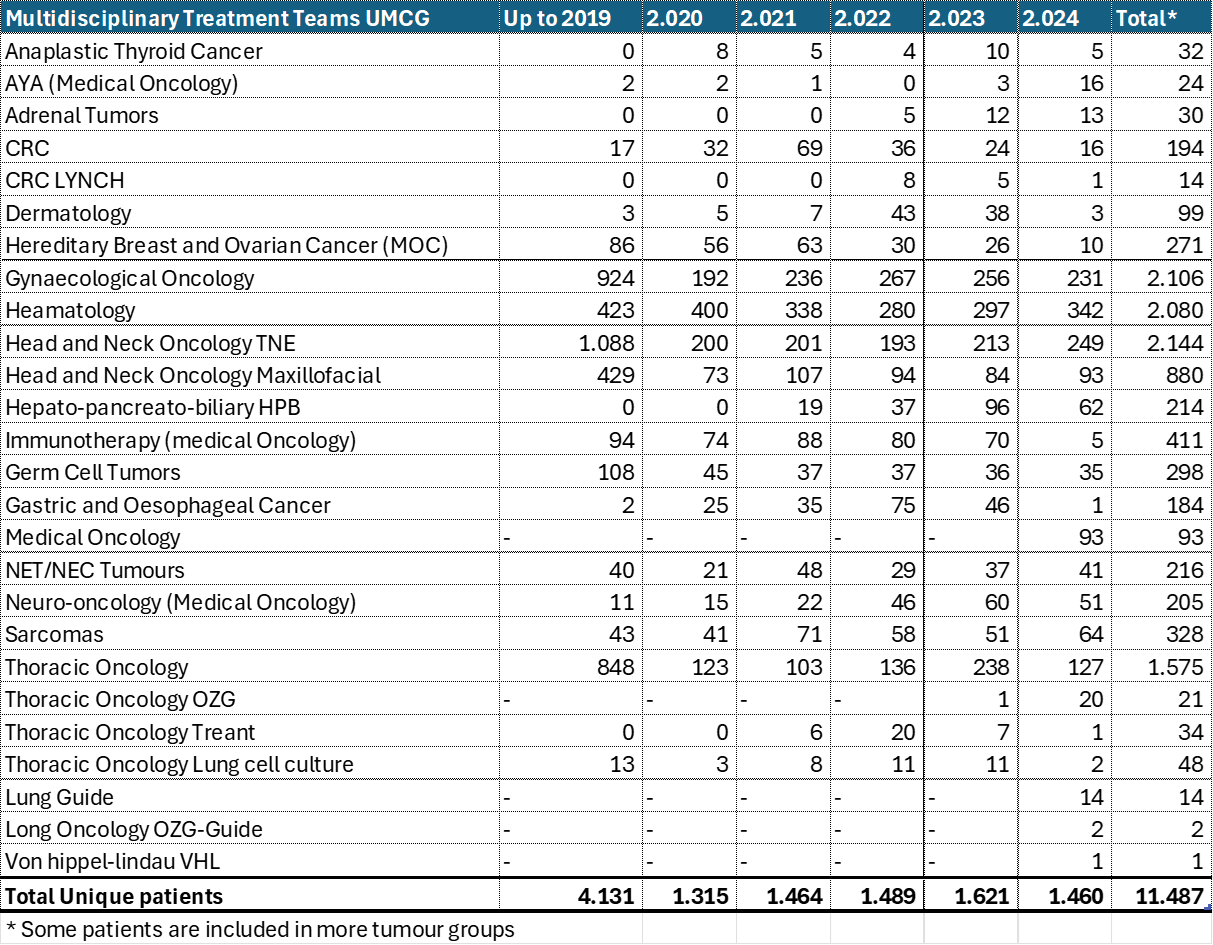
OncoLifeS is a UMCG biobank established in 2014 to systematically collect clinical data and biological materials from cancer patients, including blood, urine, stool, saliva, tissue, and bone marrow. Researchers also gather lifestyle information, quality-of-life data, CT images, and exhaled air to study treatment effectiveness. This resource supports research into cancer risk factors, prevention, treatment optimization, and improving patient well-being.Participation requires informed consent to ensure ethical use of data.OncoLifeS collaborates with UMCG departments and regional hospitals such as Ommelander and Treant, creating a more diverse dataset beyond academic care.This regional approach enhances understanding of cancer development and treatment outcomes. At the end of 2024, 26 multidisciplinary treatment teams and departments have included 11.487 patients to OncoLifeS, contributing to over 90 scientific publications and 79 research applications, demonstrating its growing impact on oncology research and its potential to advance targeted therapies and preventive strategies.
4.5.1 OncoLifeS Inclusion table
4.5.2 New OncoLifeS studies in 2024
| 1. OLS003-201400252_HNC_Amendement_3_Sarcopenie_Dysphagia Automatically delineating the skeletal muscle index in cervical CT and MRI of head and neck cancer patients. A validation of a deep learning algorithm. Team: Hurtado-Oliva, JA; Halmos, GB; Hoorn, A van der; ten Brink, RSA; Heins, J.I. Aim: To validate a deep learning model for automatic delineation of skeletal muscle mass at C3 by comparing automatic delineations with manual delineations in cervical CT and MRI scans. |
| 2. OLS058-202317897-cfDNA in NEN_Amedement 1 Exploratory study to evaluate the quality and quantity of cfDNA derived from stored plasma samples with advanced, well-differentiated gastro-enteropancreatic neuro endocrine neoplasms (GEP-NEN). Team: Walenkamp, A.M.E; Schuuring, E. Aim: Can phenotypic traits be identified in ctDNA of patients , how do methylation patterns in cfDNA correlate with the molecular characteristics of advanced. well-differentiated GEP-NENs and can they provide preliminary Insights for diagnosis. |
| 3. OLS062-202317402_GUIDE.MRD Amendement 1 Assessment of minimal residual disease by liquid biopsies in stage III NSCLC Team: Hiltermann, TJN; L.J. Dijkstra; Schuuring E. Aim: The overall objective of the study is to confirm that ctDNA detected after standard of care (SOC) intended curative treatment for NSCLC is a marker of residual disease and risk of recurrence, and applicable in clinical practice. |
| 4. OLS066-202418896-IMORT Optimized interaction between chemoradiation and immunotherapy in stage III inoperable nonsmall cell lung cancer. Team: Hessels, AC; Hiltermann, T.J.N; De Bock, G.H; Wijsman, R; Langendijk, J.A. Aim: to develop prediction models for the eligibility criteria for adjuvant immunotherapy and for anaemia and lymphopenia based on three-dimensional radiation dose distributions together with clinical and laboratory parameters. |
| 5. OLS067-202419233-LinkOncoLifePal Lifestyle and co-morbidities related to survival in patients diagnosed with cancer: a linkage between OncoLifeS, Lifelines and PALGA Team: De Bock, G.H; Vegt, B. van der; Gietema, J.A; Wekken, A.J. van der; Huls, G.A; Hoek, J.G.M. van den; Reyners, A.K.L; Hoogwater, F.J.H; Haveman, J.W; Wijsmuller, A; Ginkel, R.J. van; Dorrius, M.D; Jansen, L; Walenkamp, A.M.E; Jalving, M; Wagemakers, M; Rácz, E; Brouwers, A. Aim: What is the relation between lifestyle and co-morbidities and survival for patients diagnosed with cancer. |
| 6. OLS068-202419442 TTV in CART T-cell recipients Torque Teno Virus in patients treated with CD19 directed CAR T-cell therapy Team: Doesum van J.A; Meerten van T; Leer van C. Aim: Is there an association between TTV load and incidences of infections after CAR T-cell therapy. Is there an association between TTV load and severity of infections. Is there an absolute load of TTV after lymphodepleting therapy associated with poor/improved outcome. Is there a minimum reduction in TTV load after lymphodepleting needed for effective CAR T-cell therapy. Are TTV loads associated with fludarabine levels. |
| 7. OLS069-202419443 CD8 imaging vervolg Evaluation of cytokine production, CAR T-cell expansion and persistence, and T-cell recovery after CD19 directed CAR T-cell therapy Team: Doesum van J.A; Meerten van T. Aim: What is the impact of PPI use on Relapse free survival and overall survival in patients with relapsed large B-cell lymphoma treated with CD19 directed CAR T-cell therapy. Is the microbiome composition of patients treated with CAR T-cell therapy with and without PPI comparable to other published patient series. What is the impact of PPI use on T-cell composition e.g. numbers CD3+, CD4+ and CD8+ cells at apheresis and day +28 after infusion. What is the impact of PPI use on T-cell phenotype e.g. naïve memory T-cells, effector T-cells, exhausted T-cells. What is the impact of PPI use on CAR T-cell expansion. |
| 8. OLS070-202418828-Derma_frailty Frailty screening in elderly patients with skin cancer – an OncoLifeS study Team: Racz, E; Holman, L; Festen, S. Aim: Are all used instruments necessary for the decisions we make? Does the screening lead to less invasive treatments, less appointments, less hospital admissions, less complications? How do patients experience the screening. |
| 9. OLS071- 202419569 BANDOR Biomarkers in non-smoking And Non-Drinking patients treated for Oral squamous cell caRcinoma. Team: Aa van der, PJP; Witjes, M.J.H; Schuuring, E; Visscher de, S.J.A.H. Aim: Are there differences in biomarker expression between OSCC occurring in NSND and SD patients and what is the impact of these biomarkers on tumour characteristics and patient outcome. Secondary endpoints; Can biomarkers explain the higher second primary tumour rate in non-smoking, non-drinking OSCC patients; Which panel of biomarkers has the highest prognostic value for non-smoking, non-drinking OSCC patients on recurrence; Which panel of biomarkers has the highest prognostic value for nonsmoking, non-drinking OSCC patients on survival; What panel of biomarkers has the highest prognostic value for non-smoking, non-drinking OSCC patients on metastasis. |
| 10. OLS072-202420006 LiqMETex14 Detection of MET exon 14 skipping mutation by liquid biopsy in Non-Small Cell Lung Cancer (NSCLC) patients Team: Joosse, S; Bidisha, P; Hiltermann, T.J.N. Aim: Is it possible to accurately detect METΔex14 RNA in patient blood samples during the early stages of NSCLC. |
| 11. OLS073-202419964-SPOCOS The characteristics of oral leukoplakia patients with surgically treated oral squamous cell carcinomas. Team: Aa van der, PJP; Witjes; Tilburg van, P.F.F. Aim: What are the distinguishing characteristics, outcomes, and time to recurrence in patients who have or develop oral leukoplakia (OL) after surgical treatment of squamous cell carcinoma in the oral cavity (OSCC), compared to surgically treated OSCC patients who do not have OL. |
| 12. OLS074-202419588-MMQoLASCT Quality of Life and Work & Social participation of multiple myeloma patients treated with autologous stem cell transplantation Team: Klomberg, K.M; Gelderloos, M; Roeloffzen, W.W.H; Plattel, W.J. Aim: How does the quality of life develop during the trajectory of high dose therapy and autologous stem cell transplantation for multiple myeloma? 2. How much are multiple myeloma patients able to participate in society and work during and after first line high dose therapy and autologous stem cell transplantation? 3. What problems do patients with multiple myeloma most often face during and after first line high dose therapy and autologous stem cell transplantation? |
| 13. OLS075-202420317-LB-SCLC Liquid biopsies of Small Cell Lung Cancer Team: Hiltermann, T.J.N; Zeijst van der, B.A.M. Aim: Using an ELISA, this project will measure the presence of E18 in serum of SCLC patients. We will compare patients with limited disease and extensive disease, before chemotherapy, in comparison with (healthy) controls. Our hypothesis is that the ELISA signals will reflect the tumor mass. |
| 14. OLS076-202420309-MIMEC-study Molecular Immune profiling and Machine learning in Endometrial Cancer Team: Roelofsen, T; de Bruyn, M; Nijman, HW; Fehrmann, RSN; Bart, J; Reyners, AKL; Bijmolt, S. Aim: Can DL-models trained and/or validated on real-world OncoLifeS data predict clinical outcome and drive patient stratification for EC. |
| 15. OLS077-202420886-ICI-colitis study Clinical, endoscopic, histological and/or biochemical features associated with response to first-line immunosuppressive treatment in patients with immune checkpoint inhibitor induced colitis Team: Visschedijk, M.C; Haan, J.J; Fehrmann, R.S.N; Huitema, J.S. Aim: What clinicopathological and endoscopic features are associated with response to first-line treatment for patients diagnosed with ICI-colitis. |
| 16. OLS078-2024209 Multicenter retrospective cohort studies in Pancreatic and Small Intestinal Neuroendocrine Tumors using institutional databases/registries: Determining representativeness and FAIRness in a Dutch Nationwide study. 77 REPNet. Team: Pieterman, dr. C.R.C; Hosson de, LD; Walenkamp, A.M.E. Aim: Are the combined ENETS CoE cohorts representative of the Dutch population of patients with panNETs and SiNETs? Are individual ENETS CoE cohorts representative of the Dutch population of patients with panNETs and SiNETs? How are case-mixes different between institutional cohorts? Is there a difference in progression free survival (PFS) or time-to-second treatment after first-line therapy between institutional cohorts after correction for case-mix? |
| 17. OLS079-202420880-pharm SCT DNA medication profile in patients undergoing allogeneic stem cell transplantation for acute leukemia. Team: Woolthuis, CM; Oude Munnink, TH; Timmann, LPA. Aim: What is the frequency of pharmacogenetic polymorphisms in patients diagnosed with AML and ALL undergoing alloHSCT? What is the frequency of relevant gene-medication interactions in patients diagnosed with AML and ALL undergoing alloHSCT? How does the frequency of pharmacogenetic polymorphisms in patients diagnosed AML and ALL compare to the frequency observed in healthy controls? Is there a relationship between the presence of pharmacogenetic polymorphisms and treatment effectiveness, toxicity, and complications in patients with AML and ALL. |